
Philips connects patient monitoring and diagnostics to advance platform-based care intelligence at H

March 10, 2026
Amsterdam, the Netherlands, and Las Vegas, USA – Royal Philips (NYSE: PHG, AEX: PHIA), a global leader in health technology, today highlighted how open, interoperable, AI-enabled platforms can help health systems connect continuous patient monitoring with diagnostic insights – bringing the patient story together across time and across specialties. By connecting clinical signals with diagnostic information, Philips enables care teams to move from fragmented data to a more continuous, actionable understanding of the patient.
Health systems are under unprecedented pressure, with rapidly growing data volumes stretching clinical capacity and contributing to care delays. Delays are often compounded by fragmented data across monitoring systems, imaging platforms, and clinical applications. Philips’ Future Health Index 2025 found that 77% of healthcare professionals have lost clinical time due to issues with incomplete or inaccessible patient data [1]. As providers look for ways to expand capacity without adding burden, AI is increasingly being adopted to help automate routine tasks and surface relevant insights sooner. Yet scaling AI requires trusted, interoperable, longitudinal data that can be contextualized in clinical workflows.
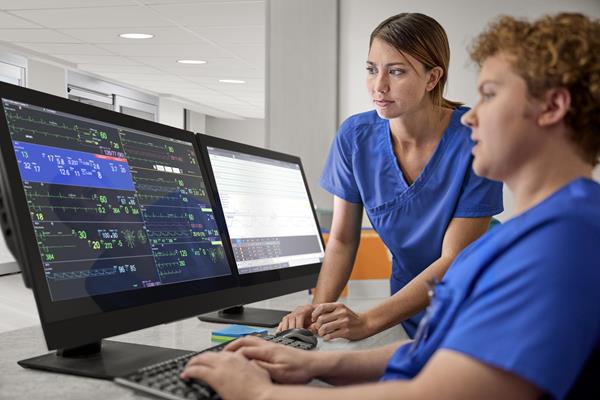
Nurses at central monitoring station
Philips’ platforms are designed to connect data, devices, and teams across care settings and diagnostic domains. By linking medical devices, patient monitoring systems, imaging platforms, and health information systems – including EMR and third-party technologies – Philips enables health systems to create a unified data foundation that supports continuous visibility and longitudinal insight across the enterprise. At HIMSS26, Philips is showcasing two core capabilities that help make this connected care intelligence possible: enterprise patient monitoring that enables longitudinal care intelligence, and Integrated Diagnostics that brings imaging and diagnostic data together across the enterprise.
“Care is longitudinal – it doesn’t begin or end at the hospital door,” said Julia Strandberg, Chief Business Leader Connected Care at Royal Philips. “When data is connected across environments, clinicians can see a more continuous patient trajectory rather than disconnected snapshots. That broader context helps reduce noise, improve situational awareness, and allow care teams to focus their time on what matters most: earlier intervention and better patient outcomes.”
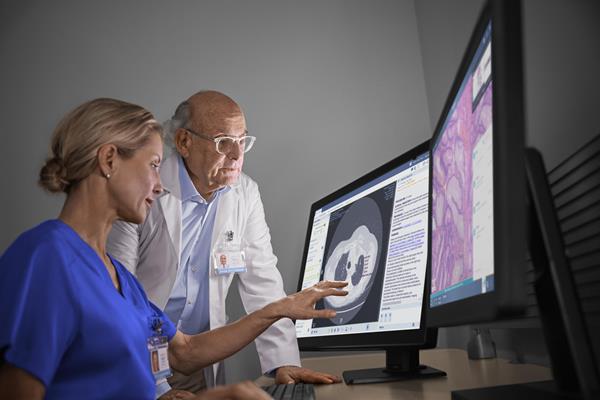
Integrated Diagnostics, radiology and pathology
Enterprise patient monitoring – enabling longitudinal care intelligence
Across the acute and post-acute continuum, clinicians need continuous visibility that travels with the patient. Philips is advancing longitudinal care intelligence by connecting enterprise monitoring with interoperable clinical data – so physiologic signals remain visible as patients move across care settings, including in high-acuity environments, during transitions of care, and after discharge.
By integrating medical devices and health information systems, including EMRs and a broad ecosystem of third-party devices, Philips helps create a connected data thread with central monitoring and surveillance workflows that support clinical decision-making across encounters and over time. This longitudinal foundation can help reduce workflow friction for care teams. Connected monitoring can also support strategies to relieve pressure on high-acuity environments by supporting safe, early discharge with oversight beyond the hospital walls.
Integrated Diagnostics – enterprise imaging integration to help reduce workload
A complete patient story also depends on diagnostics. Yet in many hospitals, diagnostic imaging data live in disconnected systems across radiology, cardiology, pathology, and other specialties. Clinicians often navigate multiple viewers, logins, and workflows to access the information needed to make decisions.
Integrated Diagnostics connects diagnostic systems, workflows, and AI applications so clinicians can access a more unified view of patient imaging and diagnostic data when decisions cannot wait. Philips’ HealthSuite Integrated Diagnostics portfolio provides a comprehensive suite of cloud-based solutions designed to connect data, integrate workflows, and embed AI across the diagnostic enterprise.
“Integrated Diagnostics isn’t about adding another tool – it’s about connecting the diagnostic enterprise, so clinicians aren’t forced to assemble the story themselves,” said Shez Partovi, Chief Innovation Officer and Chief Business Leader of Enterprise Informatics at Royal Philips. “When cardiology, radiology, pathology and other diagnostic domains come together on a connected foundation, teams gain a more unified view of the patient, time to diagnosis can drop, and intelligence can be embedded into everyday workflows in a way that truly scales.”
Philips’ platform approach is built with cybersecurity, privacy, and responsible AI practices at its core. Trust is foundational to enabling data liquidity across the enterprise, supporting longitudinal context, and scaling AI in ways that strengthen clinical decision-making while minimizing unnecessary complexity.
Experience Philips at HIMSS26
At HIMSS26, Philips is demonstrating how enterprise patient monitoring and Integrated Diagnostics can reduce fragmentation, accelerate insight, and support confident action across care environments and diagnostic workflows – while giving clinicians time back to deliver better care. For more information about solutions highlighted at HIMSS26, visit here.
[1] Philips Future Health Index 2025. Available at: philips-future-health-index-2025-report-building-trust-in-healthcare-ai-global.pdf
For further information, please contact:
Anna Hogrebe
Philips Global External Relations
Tel.: +1 416 270 6757
E-mail: anna.hogrebe@philips.com
About Royal Philips
Royal Philips (NYSE: PHG, AEX: PHIA) is a leading health technology company focused on improving people’s health and well-being through meaningful innovation. Philips’ patient- and people-centric innovation leverages advanced technology and deep clinical and consumer insights to deliver personal health solutions for consumers and professional health solutions for healthcare providers and their patients in the hospital and the home.
Headquartered in the Netherlands, the company is a leader in diagnostic imaging, ultrasound, image-guided therapy, monitoring and enterprise informatics, as well as in personal health. Philips generated 2025 sales of EUR 18 billion and employs approximately 64,800 employees with sales and services in more than 100 countries. News about Philips can be found at www.philips.com/newscenter.
Attachments
热门文章
L'ATELIER DE JOËL ROBUCHON HONG KONG 延续十八载辉煌传奇 今夏载誉回归置地廣塲
2025年TOURISE大奖揭晓:东京、纽约、安卡什与巴黎荣获首届殊荣
从“眼巴巴”到“手飒飒”,5年59次打破国外技术垄断——国家管网集团北京管道有限公司“红色劲旅自主维保突击队”攻坚实录
2025年度全国会计专业技术中级资格考试 (甘肃考区)报名公告
「全球能源循环计划」愿景发布 电池循环经济加速落地
品誉咨询——绩效破局:从 “效率优先” 到 “效能质变” 的管理范式革新